Kenya

Kenya
one of our favorite sights

Saturday, November 17, 2012

Parellel Political Seasons (Post US Election)


One of the interesting things about being in Kenya this year is that they are also having a General Election, but not until March 2013. This is the date that the government is being held to but they have changed it a couple of times already. There is skepticism in the press as to whether they will be ready.  Of course , since their system is Parliamentary it is quite different (the organization of the government ), yet it is truly democratic, in as much as the popular vote decides the winner and there are a lot of parties represented. This election is a very big deal for them for many reasons. For one, it is for all MP positions in the national government  (210 or so) as well as for President and Vice President.  Secondly, and most importantly, Kenya has the specter of a very serious violent reaction to their last general elections in 2007-2008, which scarred the country quite a bit (especially in the west) and is a central theme to most of the articles that I’ve read in the local papers. Those elections were considered to be rigged and so obviously so, that people went berserk after the President was named and he and his people decided to swear him in in secrecy during the night.  This was a clear indicator that something was fishy and it did not go over well.  The violence was very damaging to the reputation of Kenya as a leader in East Africa and a country on the move forward.  There’s a lot of information in the news and online about this period of time if you want to read more about it. Currently, here, we don’t see much evidence of tension but there have been some unpleasant events at political rallies in various parts of the country.
 Since we don’t see television, it is only through the newspaper and through conversations with local folks that we are able to glean much information about the upcoming elections.  People who we know keep telling us that they are confident that the elections will be peaceful because Kenyans realize that a violent aftermath would, once again, be terrible for the country on many levels. Last time this happened, in 2008, it affected the tourism industry which is a large part of the Kenyan economy, and it caused enormous ripple affects all over East Africa since Kenya is a major trading route between the coast and other East African countries.  The people that we know who are confident of a peaceful election tend to be educated and have a deeper understanding of the broader troubles that such violence can bring. They are also not people who get involved in such activities. Whatever the basis for their optimistic attitude, I sure hope they are correct!
A few weeks ago, while we were at the market, there were several very boisterous “parades” or “rallies’ supporting various local candidates for what they call “by-elections” which I gather is like a local primary election. Despite the fact that we read the local paper religiously, it is difficult to understand exactly what is going on and which MP belongs to which party, etc. It was sort of exciting but also due to the last election’s violence, I think people are on edge a bit because they are uncertain how things are going to pan out in the streets. Several MPs and others behind campaigns have gotten into trouble for “hate language” already.  Although the national candidates and the newspapers are touting free and fair elections with NO VIOLENCE, with a large segment of the population undereducated, poor, and frustrated with the powers that be, it is hard to predict.  So, we are waiting to see as well and we might take a little trip during the elections in order to avoid any nasty issues that might happen.
Unfortunately, the Kenyans still have a fair amount of tribalistic tendencies, and that is what motivated the last election’s violence. It’s very sad to me, because as an outsider, non Kenyan, I only know that folks are Kenyan, and only if I ask can I know which tribe or larger group they are from. I never ask because it is unimportant to me. People are people, right? From our perspective,  they are all Kenyans  and should be working together to improve this nation. However, due to the number of different tribes and peoples here, and also the history of colonization and abuse by the English and other western powers, and their relatively recent independence and foray into democratic processes, it’s not as simple as that. I find that when questioned, Kenyans don’t really want to talk about it in depth. They attribute the last round to “jealousy” or “inequity” which seems like sort of generalized blanket justification. We are sort of perplexed by the whole topic since we don’t know that many people well yet, can’t speak the local languages well yet, and are not deeply ensconced in the work world yet. Michael may get more clues to this issue when his project actually takes off.
When I reflect on the recent elections in the US it is not so very different than what goes on there still now. Perhaps it is just human nature for people to be “against” someone who is not their own kind. I personally don’t find this a particularly progressive way to think but it certainly was evidenced in the US before the election with effigies of President Obama being hung in public places (not just in the south folks, it happened in Indiana too!) or racist epithets being sworn around. In other words, in our own election, many people were less focused on the issues of the day and what the candidates were truly about than they were about what color they were or what religion they espoused.  So again, it seems it must be just the human/societal evolution issue again. We can be thankful that our actual transitioning does not beget a violent reaction in this day and age.
Now that the elections in the states are over and the concession speech by Romney and acceptance speech by Obama made, the Kenyans are interested in our process even more. Of course they are so happy that Obama won both because he is considered their “native son” and also because he is a person of color and “a good man.”  The people whom I have spoken to about our election think that we are ‘so peaceful” and that they should try to mimic us but in the same breathe, when asked, say that they “would never” vote over party (tribal) lines…curious, but not overly surprising I guess in their evolution as a democracy. The topic of our peaceful transition has been in the paper every day since our election as well as how important it is for their politicians to really work on improving things in this country rather than just becoming politicos for the sake of their big egos. I hope for this country that they can really achieve peaceful, non corrupted elections and begin to make the transition into an administration that is truly representing the needs/hopes/desires of their countrymen and women.  It is a long haul, without a doubt.

Rural Life and Food

liam and dennis building compost bins

good job!

garden progress


Since we have been “farming” in southern Indiana for several years now we are always interested in how it is done in other places. Our farm is quite small in Ogilville, but we consider it a farm nonetheless because we produce vegetables which we sell to clients and at the farmer’s market. Of course we are working against the grain in the states since most farming there is on an industrial level, but the support for small farms does seem to be growing.  However, the small or family farm is actually an almost extinct phenomenon in the US with only about  1% of the population farming in 2012 as opposed to about 18% in the mid 1950’s.
In Kenya, about  75% of the population  is still rural. People tend to be farmers or pastoralists, depending upon the traditions of their tribe.
We have had the opportunity to spend time outside of Eldoret, considered the 5th largest city in the country, and the countryside is quite populated.  Most farmers have small plots, but this totally depends on how the land has been distributed within a family. Like a lot of traditional cultures, the family’s property is divided among the male children, so what has happened is that if a father has a lot of sons (people still have big families for the most part out in the country) then the plots become smaller and smaller as one generation passes it on to the next. Therefore, you have a lot of small subsistence level farms, many of whom are barely squeezing out a living on these very small plots. The only industrial farming we know of so far is the tea industry, which is in a different region from ours, and coffee as well, both of which were imported by the British.  There are several large wheat farms nearby and there are 15 mills in the entire country. There are dairy producers  who sell their milk to a cooperative locally and many  people are growing food to take to the market in abundance.
newborn calf on farm

corn drying

farm family

huts in village

more housing

looking down on farms

farms everywhere


market stand near our house

another farm property


market haul
Kenya has a lovely climate but of course some years are better than others and that all depends on the rain.  There are 2-3 seasons here , the dry season, which traditionally has been from late Nov-March, then the rainy season from April-July, and then the season of “light rains” which goes from August-Nov. Nothing is really as predictable as it used to be, just like at home, so these seasons are changeable. This variability in seasons which farmers depend on make it  very hard. Some things are definitely universal.  Farming, if you haven’t experienced it yourself, is very hard physical work, especially when it is not industrialized. It’s even harder here where it is not even mechanized for the most part. Many  people still use animals for plowing and do all the other work by hand. It is basically back breaking work, but I swear these people are so physically strong it is sometimes unbelievable what they can do!
In any case, they seem to be able to grow a lot of varied crops, but the staples, at least in western Kenya are:  corn, kale, carrots,  onions, potatoes, and cabbage. You can also find beets, eggplant, zucchini , plum tomatoes (I have yet to see a round tomato) green beans, dried beans, and chard quite readily. In western Kenya, they  eat a corn mush called “ugali” made from their ground corn for almost every meal. They also have a green vegetable called sikumawiki which is basically shredded up kale stir fried and on the side. Kale grows like crazy here. So, this region, the Great Rift, is quite good for certain crops because it is cool, but not for others because it is too cool (no freezing but it is not hot all the time). The soil is completely different than our soil at home and we have been marveling at it since we put in our own garden a few weeks ago. It is red, for one, and very stony, and it is “loamy” as opposed to our dense clay in southern IN.  I think loamy soil means that it has sand in it which makes it easier to grow root crops but it does not hold water very well. So, we will have to water when the hot season comes on (we are catching water with a big tank). Also, weirdly, there are no earthworms. Almost no bugs at all. This just confounds us because we count on earthworms at home as an indicator of health soil!
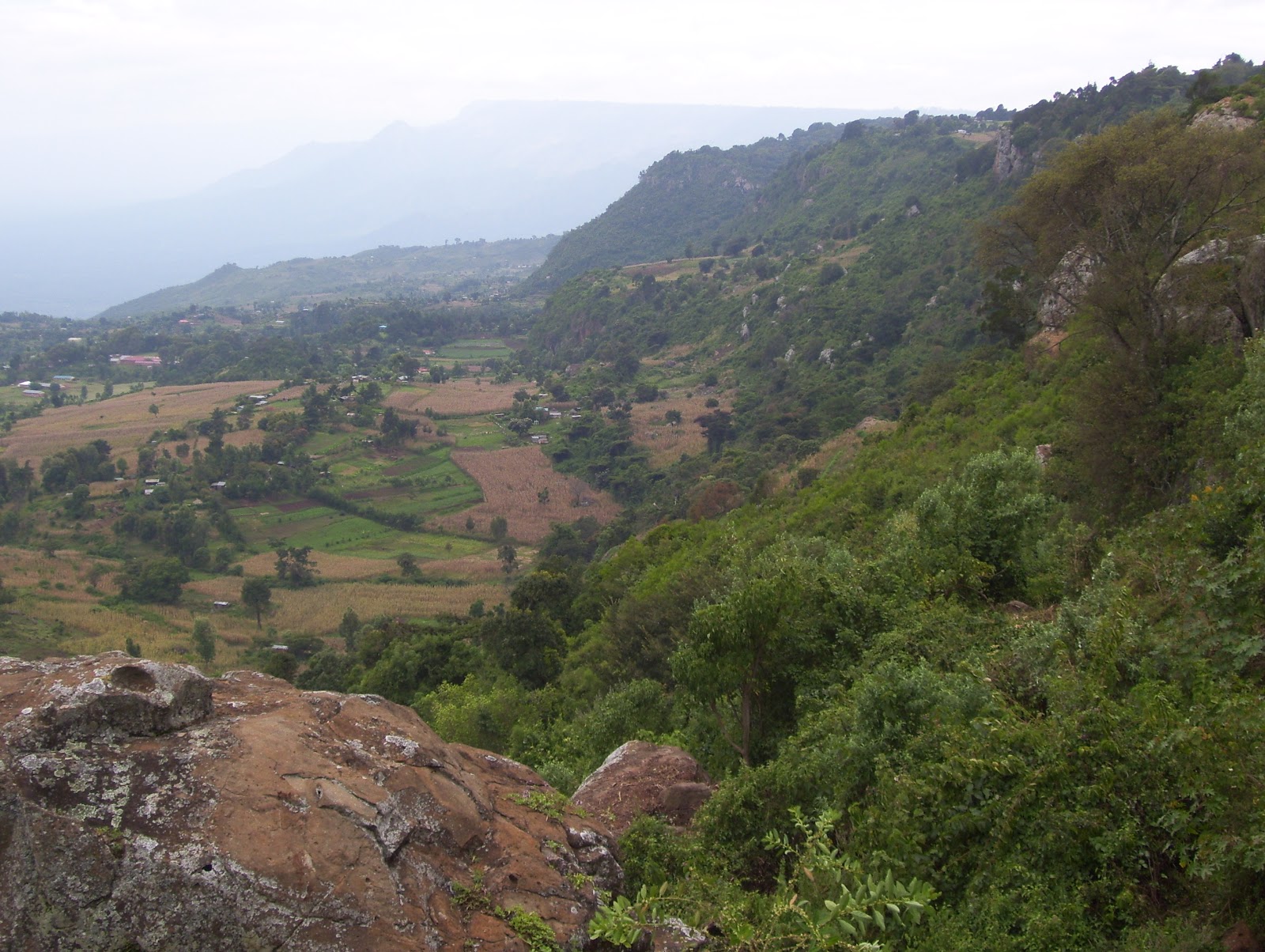
The point of all this is that the farming is done quite differently than farming in the States. It is hilly here also, since it is in the Great Rift area and as I mentioned the soil is quite stoney. A lot of the geographical phenomena in this region are the result of volcanic activity so the areas down in the valley seem to be very sulphuric and there isn’t much farming going on there presumably because of that.  What is funny is that they are farming all up the hills to the base of the cliffs. Farming and pasturing. So you have to imagine how much work goes into hauling crops up and down these steep hills and the amount of effort it must take to work against gravity while plowing and cultivating! They leave no arable spot unturned though. You see corn growing in the oddest places, between rocks, in gulleys, all around huts, etc, as they are trying to get every possible morsel of corn out of their planting as possible. 
I guess this is the true definition of subsistence farming. You farm the land that you have and you try to grow enough for your family and to be able to sell a few bags at the market. It does not seem an unpleasant life, although it does seem extremely physically exhausting. Add to that the effort to find wood or charcoal for burning in order to cook and do laundry, and the money that it takes to send your kids to school which is now required. It adds up. Some of these folks live so far away from basic amenities like shops or clinics or schools, they also have to walk quite a ways if they need anything extra. Oh yea, and water! If you have crops you have to have water. In fact if you have kids and maybe a cow or goat you have to have water too. So you might be lucky and have a creek nearby or the river, but you also might have to haul water. Yikes! It’s exhausting just thinking about it.

Sunday, November 4, 2012

Schooling Vs. Education


As previously mentioned in this blog, Liam is attending a small “private” school here in Eldoret called Potters House Academy.  It is one of several smallish private schools available and Michael chose it because it is within walking distance to the house and it didn’t seem to have a really heavy handed religious bent. Since we have been here we have learned of other schools which he could be attending, however none of them is within walking distance to our house so Liam is not particularly interested in them. Plus he doesn’t want to switch since he now knows some kids and understands the system pretty well.
Private schools are quite different here than at home. Lest you get visions of Park Tudor in your heads, let me clarify. There are many small private schools here, meaning they are privately funded and the students pay a bit more to go than to the public schools.  They exist mostly because the government schools are considered to be inadequate and overburdened.  The public schools although inexpensive,  do entail fees (they call it “desk rental”) which many folks cannot afford, plus there is the  added costs of books and uniforms.  We still don’t know where the public secondary school in Eldoret is. Luckily, we did not put him in it because the teachers were actually on strike for about 3 weeks and he would not have had much to do at that point. Plus it is far away.  
 In any case, we chose Potters and it has been an interesting and pretty challenging experience for Liam. We are pleased that he has persevered and is about to finish up the term. He entered in the third term of this school year, so he actually began as a Form I student (he should have started as Form 2). Next year, which begins in January, he will be in Form 2. He is currently taking the final exams for Form I which is a little absurd considering he just joined in the last term.  Unfortunately for him they cover the whole year but since he has figured out the system better than he had at midterms, he may do ok (he did come in 8th in the class at midterms despite the fact that he’d only been here 3 weeks).  He’s a pretty quick study but I am not sure that his study skills are exactly befitting this system.  We shall see.
Mostly for Liam the challenge has been adjusting to the system. To say it is quite different than ours is a large understatement.  He says “it’s different in every way” and since he is the one going every day I have to believe him.
The most obvious difference is that the schools are set up on the British system so the children in primary school go from Standard 1 (although there does seem to be preschool) to Standard 8. In High School they go from Form 1 to Form 4. Primary school became mandatory just 10 years ago. Secondary school does not seem to be.
The actual academic load of a Form 1 student seems rather heavy and the day is long. Liam leaves the house at 6:45 in order to arrive by 7:15. They start immediately, take a short tea break at 11 and then a ½ hour lunch at 1. They have “games’ from 4-5.  Apparently, the day is long for everyone—preschoolers on up. This may be because many kids  come from families who don’t have a lot of experience with education and studying or it may be that they don’t have electricity by which to study, or it may just be that the government thinks it is best for children to be in school all day. Liam is taking 11 classes….Computer Lab, English, Christian Religious Education, Maths, Physics, Biology, Chemistry, Geography, History, Agriculture, and Business Studies.  We are taking Swahili privately so he does not have that class, like his classmates do, at school.
 The whole of High School is spent preparing  for the KCSE which is the big exam that they all take at the end of Form 4, to see if they are able to move on in the system. It is very competitive and not a large percentage of the kids move on. Talk about high stakes! The exams come down from the national government, there are  monitors at the schools, the exams are picked up at the police department, and there are soldiers who frisk the students as they come into the school while exams are being taken. The stakes are high because a student can only go on to any sort of higher education if they do well on these exams. There are only 4 universities in Kenya although there are technical schools, business schools, etc. The Form 4 students who do well are the cream of the crop and have been preparing for this moment from Day 1 of Form 1. The exams are taken extremely seriously.
Coming from the Indiana public school system and never having had to study much to do well, Liam has has had to open his eyes to this situation and the stakes involved for his classmates. His director recently described the test taking as “life and death” for the students.  The problem is that even if a student does well and makes his/her way through the system with high marks, he or she is not guaranteed a spot in university because there are fees to pay AND it is so competitive.  However, the students I have met who do well and take their exams and therefore their futures seriously are committed to going, by hook or crook. The lucky ones have families who can afford to send them, or sponsors.
Aside from the testing  (which is also done to excess it seems…preschoolers too!) education itself is what could best be called “rote” learning. I.E. memorization. At Liam’s school, the teachers write notes on the board, which come from the books, and the students are expected to memorize them for the tests. There is no discussion, question asking, and certainly no projects. They just copy the notes. The teacher writes them on the board presumably for the kids who don’t have books as some kids can’t afford them.  Often the teacher doesn’t even stay in the room. So  Liam has learned the art of notetaking and cramming for exams, if nothing else.  We have had many conversations these last 8 weeks about the value of learning to take notes (what they do is actually copying notes) and memorization (it has its place we concede, although it is not a great teaching tool).
As many of you know,  Liam happens to be a more “hands on” learner. He probably would have thrived well in a “project” school if it were taught by an old fashioned “shop” teacher.  Aside from the possibility of failure if one doesn’t study hard or crack the system, students who don’t do well on exams get berated and often punished for not doing well. They even hit them sometimes, thinking this will “motivate” them.  That has been quite eye-opening for Liam.
It’s interesting to think about the history of public education in the U. S. and how far it has come in terms of being inclusive of all types of learners. It actually wasn’t so long ago that it was similar to this system, so hopefully it is just a matter of pedagogical evolution.  Although our system is certainly not perfect (but it is varied!) , I think Liam  is learning to appreciate his own experience at home a bit more. Due to space and financial constraints and for all sorts of other reasons, the system here is not all inclusive and children who don’t do well are not offered options. In fact, the result of thousand of kids not doing well and getting shunted out is a lot of young unemployed or undirected people on the streets. So, it pays for a student to take his studies seriously and learn to take notes well and pay attention and do well on tests.
Liam does seem to be getting the cross cultural experience that we had hoped for him and I think he absolutely gets now why that is valuable. It’s definitely a “Character Building” experience, as my dad used to say, and no doubt it will serve him well as he matures.
So, we are a little up in the air about the future of Liam’s HS education.  Clearly Liam needs to finish his HS diploma but it’s not going to really help him to study for the KCSE as he is ultimately not going to go to university in Kenya. He may one day want to go to university in the States and he needs to get his HS diploma from Indiana. So, we have begun signing him up for HS classes online.  The question has become whether it is more valuable for him to have some free time to do other things, like volunteer in the community and with certain AMPATH programs (they have a farm and an arts workshop), than sit in school memorizing text all day long (they also go on Saturday). We are pretty convinced that he can get a lot out of the volunteer experiences, AND practice his Swahili more if he had time to do that. He says he gets more out of walking downtown on a given Saturday afternoon and going to the market than he gets from sitting in the classroom for a week!
The question is whether the actual academics of this school are going to help him, though. We will be pondering this over his LONG break coming up soon! Needless to say, he is looking forward to this break and there are several more opportunities becoming available to  him so that he can keep busy and build stuff and be outdoors. We have new friends who run children’s homes here who need help building a playground and we are building a small play area outside the burn unit at the hospital which he can help with, and he gets to go help on the AMPATH farms and the Kruger Farm too (that’s where the giraffes are). We also plan to do some travelling.  So, he will get a lot of cool experiences in before school starts again in January.  Stay Tuned for more on Liam’s educational experiences in Kenya!
dog wrestling...a new pasttime!

early morning veiws of  the valley

views of Kerio Valley early morning


acacia covered hillside

termite nest

down in the valley


new discovery! Sego Hotel in Kerio Valley


views from hotel in valley where we had coffee


hike on a cow path

overlooking valley

farms in the valley


mountain man


Liam buying bananas at the market on the way home
The photos included  come from a day trip that we took today into the Kerio Valley.