Kenya

Kenya
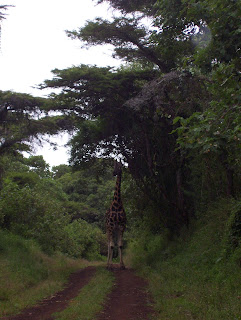
one of our favorite sights

Saturday, January 5, 2013

December 2012 Travels

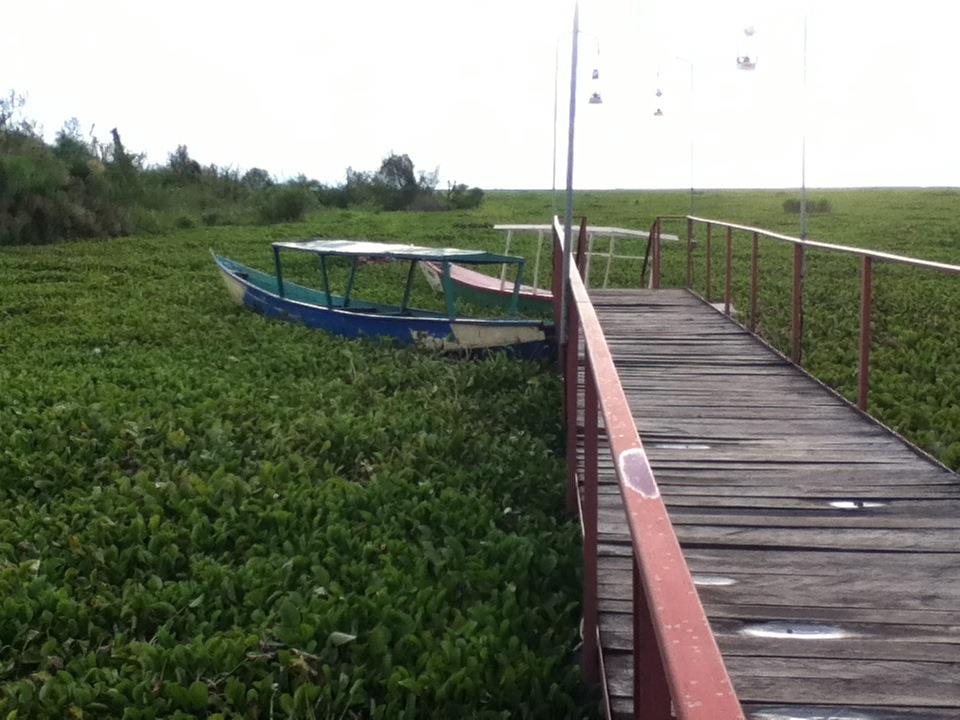
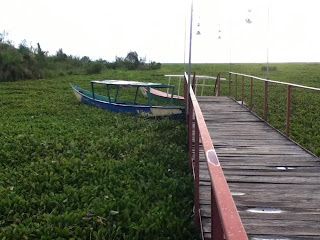
water hyacinth at Kisumu harbor


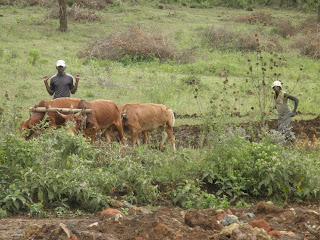
plowing after a rain

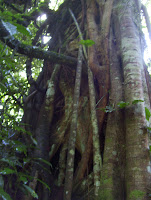
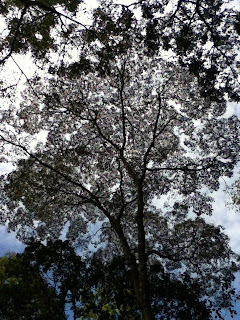
fig tree in Kakmega

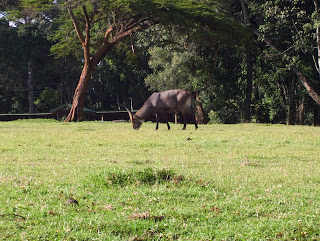
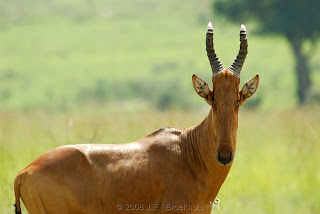
Bush Buck in Mt. Elgon Nat'l. park

Mt. Elgon park


Colubus Monkeys

Mt. Elgon Park

Mt. Elgon park

Mt. Elgon park


Dikdik

Bush Buck

Topi

Canopy at Kakamega

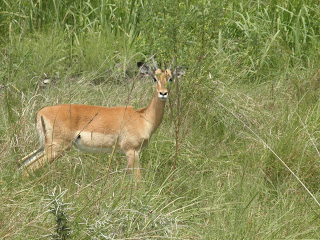
Impala

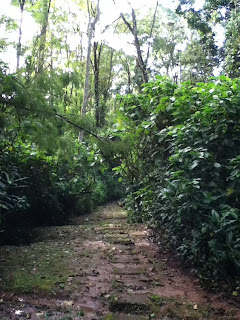
Kakamega

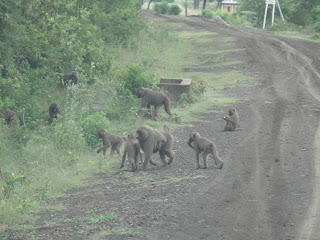
Olive baboons at Mt. Elgon

climbing to see the canopy at Kakamega


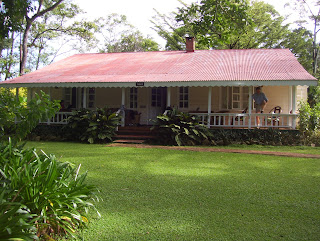
cottage at Rondo


whacky stork

part of road to Lake Victoria

Lake Victoria sunset


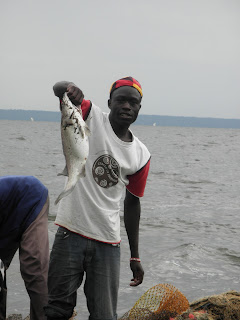
Nile Perch! the big prize!

Our desire to get out of the city and check out some new places became stronger in December and we had the opportunity to combine a work related visit with a visit to an orphanage near Kitale for our church, and  visit Mt. Elgon,  which straddles  the border of Uganda.
Mt. Elgon is the second highest peak in the country, after Mt. Kenya. Since coming to Kenya, we had learned about the volcanic history of Kenya which of course offers many interesting geologic sites and features and Mt. Elgon National Park promised to introduce us to some of them.  Word was also that there was wildlife there and cool caves to explore. So, we were raring to go check it out.  We rented a banda, which are provided by the Kenyan Wildlife Services. Bandas are small buildings, sometimes huts, often made of concrete with a circular shape and a thatched roof. The bandas at Mt. Elgon were concrete block with a small kitchen and front porch. They were perfect for us. The three of us could stay the night, bring in our food and water, and have a nice peaceful sleep for $35.00. This is pretty cheap for the Kenyan National parks as many of the parks are centered around tourist safaris and are quite expensive even just to get in the gate. Due to its remote location, Mt. Elgon NP is not so heavily visited and therefore quite a bit cheaper. But, no less interesting, to be sure!
We were met at our banda by David, a Kenyan trained in hospitality who has been working for KWS for some years. He was delightful to talk to and full of helpful information. Since we were staying in a park which claimed to have some large animals,  I personally was a little nervous. In fact, upon our arrival at the park , after paying at the gate, we immediately saw baboons and Bush Buck antelope, which we considered a good sign. We took a short walk after arriving at the banda and heard some funky loud noises in the bush (rutting water buffalo?)  and saw several smallish antelopes and a lot of large animals’ poop. So we knew they were there! When we got back to our banda site, David had prepared a large bonfire for us so we made some dinner and sat around a lovely campfire, chatting with him for a bit. I asked him , since I really had no idea, what one does if one comes across a large animal and one is on foot (they actually recommend an armed guide but we were not interested in that). He said, in all sincerity, in beautiful yet heavily  accented English, “well, if it is a water buffalo, he is the most likely to kill you. You must quickly climb any available tree. However, if it is an elephant, you can just take off your clothes and run into the woods!”  Although I chuckled at this assessment I did demand a “plan of action” from my guys the next morning before we went out , seeing as how I’m not a strip and run naked through the woods or climb a tree quickly kinda gal. Michael thought my slight discomfort was humorous but I was very clear about my plan. “Play dead” was my plan. The men of course thought they could outrun a water buffalo so I just said “good luck with that!”
That night was beautiful  under the star strewn sky. It was super dark so the stars were particularly brilliant and we were able to use Liam’s “stargazer” app on his Ipod to find stars and the names of constellations. We all slept well too, as it was pitch dark and very quiet.  Michael and I got up early, at sunrise , to see what animals we could see and sure enough we saw some Bush Buck  and DikDiks in the glade near the bandas. We then got Liam up  and took a walk up the road which was surrounded by heavy forest. We were being as quite as possible so as not to disturb the animals. On that walk we saw some more African deer,  and to our delight,  a herd of zebra wandered out of the woods just as we returned.
David had convinced us that we could take our 4wd rental up to the base of the mountain peak and that it wouldn’t take as long as we had thought, so we had a quick breakfast, packed up and headed out , our first stop being the Kitum Caves, which the elephants are known to enter in order to dig for salt. Keeping our fingers crossed for elephants, we hiked up the lovely hillside, catching glimpses of Colubus monkeys in the trees on the way up.
The cave itself had sort of a tricky entrance but once inside there were signs of elephants having recently been there and you can see the lava tubes from 10 million years ago which formed when the volcano last erupted. So cool! We continued on our way, driving about 35 km up the mountain, enjoying the changing flora on the way up to our ultimate goal of 4000 meters, the air thinning as we went. We saw several more large Bush Bucks along the way and made several stops to admire the giant trees along the way. The road itself became little more than a path at some points and there was no sign of humans at all.
 After a couple of hours of driving we did find the trail to the top of the mountain, which was surrounded by  beautiful savannah and several  other peaks all around. We hiked a bit to the trailhead but as we approached it began to cloud over. My reaction to the climb was a positive “maybe” because it looked like 4 km of steep and stoney uphill which at that point in the day I was not sure I would be happy to do. Plus we knew we had to get out before dark. We headed up the rocky trail and it did become slippery and sort of invisible in places, but my heroic helpers, lent me a hand. After about an hour we stopped on a stone outcropping to drink some water and find the peak as there were several looming. I was not overly enthusiastic about continuing but Liam was, so he and Michael carried on promising to come back in 20 minutes. I sat on my rock and looked in awe at the scenery and listened for sounds of approaching wildlife. It is something else being out in nature when you know there are large animals about. I began to get a little worried when suddenly, a fog moved in and I could not see where the guys had gone.  I stood and called to Michael and Liam and got what I thought was a response back so I “chilled” for a bit and then finally, after another 10 minutes, saw them in the distance. We all agreed that we were not prepared to hike the whole way that day as it was late, we were tired and out of water, it was misting, and we didn’t really know at what point we’d find the peak.  We do plan to go back.
After resting a few minutes at the bottom of the hill, we hiked back to our vehicle and climbed in, prepared to descend the mountain and head for home. We couldn’t go fast, because it was wet and tight, and at one point we even got stuck. Michael sounded a bit concerned which was a red flag for me, but Liam and I were able to get us out by putting debris and sticks under the tires. Since we hadn’t seen any other people for hours, including park rangers, this was a little bit of an “uh-oh” moment;  we did get lucky I think. As we continued down we got lucky again, in finding standing smack in the middle of the road a very large giraffe, eating a late afternoon snack of Acacia tree. Giraffes are just so awesome and we were all tickled to come across her. We slowly got out of the car to get a better look and she just stood and watched us as we watched her. We walked a bit closer, took some photos, and just continued to gaze at her when finally, after about 15 minutes, she turned around and trotted off.  Such grace and beauty to behold. Just seeing her made it all worthwhile for me.

Christmas in the Rainforest
We were pleased and felt lucky to be invited to join the Mamlins (Dr. Joe and his wife SarahEllen who have been directing the IU Kenya program for quite awhile) over  Christmas in the Kakamega Rainforest at a retreat center called Rondo. We had expected to maybe take a trip to the coast because we are all missing water but things are a little tense on the coast and we couldn’t pass up this invitation. We had been to Kakamega before and really enjoyed being in the rainforest. Another cool thing was that the Mamlins foster son, Dino Martins, who is a quite famous entomologist, joined us. He is studying insects all over East Africa and has a wealth of knowledge about everything in nature, and is just a pleasant and interesting guy to talk to. We took several hikes with him as he was searching for specific bees and butterflies (pollinators are his thing) and we heard lots of stories about his other research projects which sound so interesting. He is currently working with Richard Leakey up in Turkana.
Kakmega is a 230 sq mile swath of rainforest in the heart of an intensely cultivated area. It has been protected since the 1930’s and is managed by KWS and a community forestry group. There is a lot of wildlife there and it is known for some particular animals, the Colubus monkeys, red tailed monkeys, blue monkeys, and birds, such as the Blue Taraco and Casqued hornbill. Since both Dino and the Mamlins were way into birding we did a lot of that. However, we Grevens, we have a particular fondness for monkeys because they are so active and funny, jumping from tree to tree. At Rondo, there are many monkeys in the trees around the yard, and in the early morning we would wake up to monkeys right up close to our cottage. So funny! One of the coolest things was the Colubus monkeys waking up the forest in the early morning, just before dawn. They have this wild low call and it starts somewhere deep in the forest and moves across it waking everything up as it gets louder and louder. Sort of chilling and spooky, but really awesome to hear every morning! We spent three nights at Rondo and had so much to do and see and talk about that it really made our first Christmas away from family and friends tolerable.
On December 26 we headed out to the next leg of our journey. As I mentioned, we were missing water, as we are “water people”, so we went  down to check out Lake Victoria, which is in the south western most corner of Kenya.  Lake Victoria is the second largest inland lake in the world (second to Lake Superior) and the largest freshwater lake in Africa. We love lakes, so we were excited to go and see it. We headed to an island on the far side of the part that is in Kenya, called Rusinga. Its biggest claim to fame is that it was the home of one of the early independence fighters/trade unionists, Tom Mboya. He was assassinated back in the early days after independence.
Most of Lake Victoria is actually Ugandan and Tanzanian, but the folks who live along the edge of it in Kenya are certainly dependent on it. It took us about an hour to get to Kisumu, a biggish city along the way.  From Kakamega to Kisumu,  the road was good, but after that the road deteriorated quite badly and it took us another 3 hours to get to the island. Sadly, the whole area just struck us as really poor. Poorer than this region, which says a lot. The folks are living very hand to mouth, they usually only have one growing season and the only industry they have is fishing, which they do in a very basic way. WE saw people carrying fish (Tilapia or Nile Perch ) on bicycles, by hand to the market and hawking them on the street. We stayed in a little beach “resort” owned by an older American woman who had married a Kenyan from that area and retired there (she had been widowed quite awhile). She is an artist and has created this nice place for relatively cheap, with a nice staff, cute bandas, and good food.
 However, the biggest and most interesting aspect of the visit was that we couldn’t swim in Lake Victoria!! We were so bummed. Well, people do swim in it, and of course the Africans get in it, but  because it has Shistosomeisis in it, which can cause all sorts of problems, we decided, although it was hot and steamy down there and very tempting, that it definitely wasn’t worth it.  So we checked out the island, birdwatched, saw two beautiful sunsets, slept peacefully in our bandas, ate well, and pondered the life of islanders who cannot use their lake for a tourist attraction. Don’t get me wrong, it was beautiful, but noticeably underused and presumably because of the shisto. No sailing boats out on the water (fishing dhows, yes), no snorkeling or other boating activities. Such a shame. And no doubt if it was a healthier body of water, there would be more money to go around on the island.
 But the bigger shame and startling discovery came on our way home when we stopped in Kisumu, which is a port town. Its port, and all the other ports of Lake Victoria are now covered in water hyacinth, which is an invasive species which was somehow introduced from Latin America about 20 years ago. It is everywhere in the harbors and bays and sadly it is killing the fishing industry, the tourism industry in the port towns, and it is very bad for the ecosystem of the lake. It is worse near Kisumu because they dump a lot crap in the lake too. So, our visit to Lake Victoria was both interesting and sort of depressing.
Happily, on the way home, we stopped at Ruma National Park, which is a lovely remote park down by Lake Victoria and surrounded by beautiful hills. It was truly picturesque and we spent several hours looking for wildlife. We were pleased again to be treated to the sighting of many giraffe, zebras, Impala, Topi, and Jackson’s Hartebeest. That was a lovely way to end our journey before getting back on the very unpleasant and bumpy road home.
Well, this is an extra long post, but I hope you have been able to enjoy it. I am including some book titles and websites that may help illuminate some of the above topics.
Happy New Year!
Walking Together, Walking Far by Fran Quigley, History of IU Kenya/AMPATH IU Press

What Sticks

  
Kitale Children's home 

Dennis Juma on his 12th birthday

julius and paula

julius came in very malnourished but is doing better!

ngannga is Julius' brother. they are both abandoned.


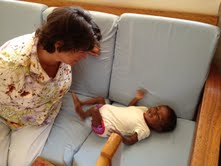
Paula was abandoned at birth. she is 10 weeks now.

Lewa Children's home

Sally Test Pediatric Centre

Sally Test Pediatric Centre

Sally Test Pediatric Centre

Lewa's baby room

Paula at 6 weeks

Preface: I want to thank everyone who sent donations for children’s scholarships and water filters. The water filters will help impoverished people save on fuel costs as they won’t need to boil water, yet they will have clean water. Also, Many families cannot afford the fees for school here,  and there are children in homes who need sponsors. Education is the only way out of grinding poverty here. We hope to set up a 501 (c) 3 soon so that you can also get a tax deduction for your donation. Anyway, your generosity is appreciated and MUCH NEEDED. READ ON
What Sticks
It’s interesting after being here for several months and spending time with many different non Kenyan folks who are here for different reasons, what sticks for folks. There are many who are doing really important scientific and medical research, there are others who are doing sociological research, and others who are practicing medicine (although usually the docs are doing both).  There are others who are here on “missions” and are working in hospitals or schools or with youth.  Since I have no specific role I have found myself drawn to and pretty absorbed in the lives of the parentless children of western Kenya. I have been spending a lot of time with abandoned and orphaned babies/children in different settings. 
When I close my eyes at night, resting assured that my own children are safe and sound, I see the faces of these kids.  They are what stay with me. There are an estimated 2.5 million orphans and abandoned children in Kenya. They are little bitty babies, toddlers, small children, school aged children, and adolescents who have no one. Many children end up in the hospital abandoned, or in the dump, or on the street, and they are the kids I am working with here in a day care center and at a children’s home and a center for street kids. These children, with their beautiful smiles, little needy faces and hands, warm greetings and childish laughter run  to greet me, hold my hands, reach to be picked up,  always with a hopeful smile on their faces.
 Then there are the street children we see every time we are downtown; some of them are older, and this has become a way of life….however, many are young. They are all  barefoot, dirty, hungry, begging for coins and food,  or huffing glue on the street, walking through the trash piles looking for something to sell in order to buy a morsel of food. It’s a devastating sight even if you’ve seen it 100 times. It’s not one you easily get used to.
Poverty, as we all know, is tough on kids here and at home. I learned a lot about poverty when I became a CASA volunteer in Columbus several years ago. The facts are the facts and it doesn’t matter where you are. The results of severe poverty, disease, family dysfunction , drug and/or alcohol abuse, are even tougher on kids and ought not occur. It ought to be illegal. But, it is not and it happens all over the world.   All of these issues combined with a devastating pandemic like HIV/AIDS create the situation that you find in Kenya and all of the African countries now.  I have big hearted friends who work with AIDS babies and their families in other countries so I was plenty aware. I had even  done what little I could do as an activist raising funds for AIDS relief (Michael and I both). That’s how we got involved with IU Kenya in the first place. But I’ll tell you what; knowing it and thinking about it are TOTALLY different than living among it.
HIV/AIDS infection rates have gone down but Kenya lost millions of young adults as it cut its murderous swath across this country, leaving behind the children of those adults. Many of them are HIV positive as well, and hopefully, they are in the care of organizations like AMPATH which has made a huge difference to western Kenya in terms of treatment and sustaining families.
 I ask myself on a daily basis, “ What is going to happen to these kids?” The AIDS babies and all the others that are the result of desperate poverty.  The lucky ones are the ones who’ve been taken in somewhere. They at least have a bigger chance of survival, a bed, food, and possibly education.   You can question how desperate one must be to give up one’s child/ren. You can swear you can’t imagine. You can “pray” for them I guess.  But, for me, the key has been finding some way to DO something.
I began helping soon after my arrival and now I’m hooked.  I can’t NOT do it even though it is heartbreaking and physically difficult. Holding babies, changing diapers, rocking them to sleep, feeding them, singing to them, carrying them to and fro to get them to go back to sleep, or just laying them down and watching them kick and find their fingers are all a thrill to me. A smile from one of the little infants that has been abandoned and/or undernourished, and is on the road to good health, knocks me over. I am a little beside myself with it right now because I have been spending time with these same babies for some time  but I know that there will be hundreds of others before I leave Kenya.
I have met some incredible people here dedicated to helping the children and they are what gives me the least little bit of hope. People like SarahEllen Mamlin, who began the Sally Test Center at the public hospital, Moi Teaching and Referral Hospital, because after going into the kids’ wards she couldn’t stand the fact that there was no place for sick or abandoned kids to be or play other than the wards. Some years ago an Indianapolis philanthropist put up the money to build Sally Test and it is such a great little oasis for the children who come in sick and/or are left behind by sick,dead , or desperate parents. Again, it is not an easy place, but the staff is SO awesome and loving and the facility is similar to an American daycare center without some of the fancier amenities. SarahEllen has managed to get a fair amount of support for clothing, toys, and books from friends and her church community in Indy. Sally Test also teaches sewing skills to women who come in with sick kids and has a “childlife” class for parents every week.  However, money is always an issue.
Many of the kids from Sally Test end up going to one of the many children’s homes here in Eldoret after some time there. There is a court system process and being new, I really had no idea what happened to some of the kids but I’ve been reassured that they are going to these registered “children’s homes.” I’ve met several of the families/individuals who run/own them as well. Many of them are funded by churches stateside and although my first reaction to missionaries is  usually a bit skeptical,  these people have some seriously big hearts. IF this is what their faith drives them to do then I say “Allelujah! Bring it on!”  I know people who wonder the slums looking for abandoned babes. I know a pastor who has successfully raised children in his home in Kibera, the biggest slum in Nairobi, and had them go on to college. I know others who foster 5-6  teenagers at a time…..again, money is always an issue.
 There are different qualities of homes and different forms but all of the folks I’ve met involved in this work so far have been high level loving people (I’ve met  5 couples who do this work so far). If the basic goal is to keep kids off the street, where safety, hygiene, and health issues abound, AND there’s no future there without some kind of help, then so be it. I often have to shake my “developed” country standards and realize, that even though I truly believe every child needs and deserves love and individual attention throughout his/her childhood, the solution here is all relative. A group home is better than the street. So is the hospital ward. At least there are some adults paying attention.
So , what does one do when one also has a thing for kids, can’t bear the thought of yet another kid living on the street, or ending up in a home where he or she may just be one of a crowd of underloved kids? Also, what about those street kids? Can you just walk away? Michael and I are in constant conversation about kids, I can tell you that.  It’s not unlike how we feel about global warming. It’s not acceptable and something must be done. But what?
As helpless as we feel sometimes, and as confounded by the extent of the poverty, we are working on some ideas:
1) we are trying to get a project going  with the local drop in center for street kids to help get some of the older kids off the street and make a little money 2) I spend time volunteering at Sally Test. They need the help. 3) I also go out to this Children’s home that now has 9 babies and not enough caretakers. I take them stuff…formula usually, and help with the littlest of the littles. There are babies there that are just 8 weeks old. 4) we are sending our neighbor boy,  Dennis Juma, who is being neglected by his family for many reasons,  to school  as he was not in school last term  and he needs to be in school. He has become  like  Liam’s “little brother”  and he spends a lot of time at our house…eating, showering, toting water,  and playing mostly.  He has been fatherless for all his life so he looks up greatly to Michael as well. He’s one fewer kids on the street, we figure.
So, I shut my eyes and have sleepless nights worrying about those babies. I cry a fair amount. I think about my own children and how blessed and privileged they and we are. I count my blessings everyday.  That’s about it. It’s all I can do at this point.
Here are some interesting links on this topic:
www.ampathkenya.org                /our-programs/children’s-services/sally-test-pediatric-centre-(stpc)/
www.facebook.com/lewachidrenshome              (children’s home near Eldoret)
www.kibera2.tripod.com  (children’s home near Kitale)
www.tumainicenter.org (street kids in Eldoret)

Friday, November 30, 2012

Alternative Christmas Gift Ideas From Our Family to Yours!


Here are Five Alternative Gift Ideas  for Christmas that will make a REAL difference in the lives of Real People that we know here in western Kenya!

1. 1.  Purchase a Maji Safi water filter for a family or a children’s home. These cost about $15 apiece and are good for 5 litres  of filtered  water per hour.  Many families do not use clean water and others  boil their water but they have to use wood or charcoal, both of which create green house gases, cost money and are bad for their pulmonary health.
2.  2.  For $200 you can sponsor a primary school child to go school for one year at Bidii Primary the school where we are helping to raise money to build a new school. This includes uniform and books. *
3.  3.   Purchase a solar light for a family without electricity so that the kids can study after dark, etc. Solar lights are for sale in Eldoret for $25 and there is abundant sun!
4.  4.   Make a donation towards the borehole which needs to be dug for Bidii Elementary. It has been assessed that the grounds for the school will accommodate the water for the school but a borehole (a well, basically) needs to be dug in order for the children and the school to have water. The total cost for the borehole will be $2500.00.
5.  5. Sponsor a child to go to school in a children’s home in Eldoret or Kitale to go to school or just make a donation towards the schooling of a child. The annual cost for primary is around $200.00. There are 2.5 million orphans in Kenya and many many children’s homes  struggling to take care of them. Most of them have funding issues and they all must pay “fees” for sending each child to school and for uniforms, and textbooks.Often only the kids who are "sponsored" get to go to school.

If you have any desire to give a gift of this sort, please send a check in my name with whichever one you’d like to support on the memo line c/o Kathleen Leason 660 Terrace Lake Dr. Columbus, Indiana 47201. We are happy to send you photos of kids, children's homes, etc. so that you have a photographic verification of your generous gift! At this point, we do not have a 501 (c) 3 set up nor do the AMPATH related Children's homes. There is a fund through IU Foundation for the abandoned babies center where I am working. If you write a check to IU Foundation for this purpose write: " IU Foundation/Sally Test Center" and hopefully those funds will make it to the center.

THANKS AND HAPPY HOLIDAYS!

*There are photos of the school, grounds, and children on my blog site, www.grevensineldoret.blogspot.com The post is called “A Warm Karibu for Us”

Saturday, November 24, 2012

Is There a Lowe's Around Here?


As people who have spent a fair amount of time in hardware stores over the years, both the big box kind and the little old neighborhood variety, we tend to look for/in them wherever we are. Not surprisingly, there are no Big Box hardware stores in Eldoret, Kenya (there is a grocery store that is verging on that status but it is Kenyan) but there are lots of small hardware stores.  At face value, that seems really awesome. However, we have had a few small projects and incidents occur which have made the existence and convenience of something like a Lowe’s more appealing than one would expect. Yep, we, who generally have disdain for  big box stores in general and complain of their ubiquitous existence at home, have actually LONGED for Lowe’s recently. Menards would even do in a pinch!
One reason is that our drill broke. It actually exploded, or got fried, or something. I am not sure, as I was not there, but the tale that is now told is a sad one. Michael and Liam both love our drill. It’s cordless and strong enough for most household projects; HANDY, you might say.  And we hauled it and its charger all the way here, even having it nearly confiscated at customs in Nairobi. Anyway, it was the wrong voltage for the electricity here, so we bought a transformer to charge the battery. We looked and looked for the right one in all of the little electronics shops in town and finally found one which we were promised would do the trick.  It did not.  In fact, it had the opposite effect. So, we have been without a drill since that unfortunate day. A very sad state of affairs in this small project-minded household.
 Recently, Michael and I went on an excursion to look for drills, in case they might have one similar to our now dead one, in one of the many hardware stores in Eldoret. We went to what is considered the “best” one, i.e. it has the most stuff. No, it was not even close to Menards or Lowe’s. It did have drills, though, and screwguns (another favorite of my menfolk). However, they were SO expensive it was kind of shocking, and , even weirder was that they weren’t new! They were refurbished and all were over $200.00. A similar drill at home would cost about $60.00. Although discouraged, we did find this hefty pricing illuminating. Due to the cost, we probably won’t buy one and we have lately found out that IU has one that we may be able to borrow, so we are fortunate. Also, a new friend  who does maintenance work for children’s homes and has Liam help him build playgrounds,  has loaned us one for our current big project at our house (a basketball goal… see attached photos).
Aside from noting the availability and pricing of small hand tools, there are a lot of things going on here which as builders, or “construction people” we notice. There are a few mysteries for us here, though, aside from the price of tools.  Take for instance the current public works job that has been going on outside of our house for the past week. It is a wonder of a job. We walk by every day and we wonder…what is going on here? Michael has done a lot of road work in his career and his observation of this one is that it is mysterious.  
Coming from the US where everything is designed to be as efficient and easy and convenient as possible, almost to a nauseating extreme, there are so many things that go on that just don’t make sense to us, yet they are totally accepted as status quo.  We know that a lot of it has to do with availability of equipment, materials, etc, but what is surreal is here in Kenya,  they seem to be struggling with what seems like basic stuff,  yet they are quite advanced in the more high tech fields, like internet access, moving money by telephone, and cell phone technology.  The contrast/conflict  between the modern world and the developing world is all taking place right here. There surely is a reason why but we have yet to figure it out.
Take for instance,  when the guys were  working on the road outside our house. Now, first of all, they were digging everything by hand, which is fine, slow going, but fine and pretty precise. Digging dirt out of the sides of the road with shovels and pickaxes, and then carrying the dirt with broken down wheelbarrows to where I am not sure. Using sticks as markers. Not sure what the end goal is, but it seems they are going to pave this little lane to our neighborhood and that it must be part of the city’s  overall “public works” projects. And it certainly employed a lot of men.  All good. But, someone hit a water pipe, the main water pipe to our neighborhood, and then there was water flowing everywhere in large quantities. I happened to walk by then, and found them struggling to stanch the flow of water with the most handy of dandy things, Plastic Bags and electric tape (which Liam had given them upon request). The flow was  strong so I was pretty sure that this was not going to work for very long and I mentioned this to Michael who went out and found out who was responsible for the broken pipe so that we wouldn't get charged. They lost a lot of water. The work continued throughout the day and the plastic bags were wound and rewound around the pipe. By the end of the day, no one had come to fix the pipe and the plastic bags were holding….I just hope they don’t bury the bags on the pipe rather than actually fixing it. Michael says they may not have the tools or materials. (this is day 5 and the pipe has yet to be fixed. Glad there is not a drought anywhere in Kenya right now! Ok, day 6…the pipe is fixed and buried….let’s hope it holds!)
Another fine example of this surrealism  is that there are a million, or at least 30, small Indian owned hardware stores downtown. However, they don’t carry all of the various materials that one might need for a building project! We have been trying to get the materials to put up a basketball court for 10 weeks. Michael bought a hoop, at the school supply store, then had to go have it rewelded because it was not welded well at the back. Then Liam cut a piece of plywood that we had found for the backboard, and painted it. Then we had to go find two 2x4 8 ft. boards to nail to the fence posts so that they can hold the backboard up. Well, that turned out to be an interesting effort. We walked around downtown and went to 5 or 6 “hardware” shops, and no one had “timber” for building. Finally we ran across a store owner who directed us to go the “fundis” who build stuff and buy the wood timbers. He said no one else in town would have them.
So we wandered into this interesting little area of “fundis’ who were working on cars, taking out whole engines in a greasy mess, sawing wood, making coffins ( handily you can get one made cheap right there in that little zone!) making clothes, etc. We found the guy who seemed to own the saw and there were boards! Yea! So we had a long broken Swahili-English conversation about purchasing two 10 ft. boards that he would have delivered (we hoped) to our house, since we don’t have a vehicle, all for $10. We left pleased that we had found the boards but not at all sure that we would get them anytime soon. They did arrive later that day, pushed by a laborer, on a dolly, about 3 miles to our house. The final thing that we needed, besides borrowing a drill from someone, were some bolts, to hold the metal rim to the backboard and the boards to the fence posts.  Because of the weight of the backboard and the posts, we needed special bolts and wood screws. These turned out to be hard to find as well. Michael and Liam visited at least 5 little hardware stores in town, none of which carried bolts or screws. There was one store that had a bad selection of screws which were flat heads and according to the familial experts, they “blow” because you might “break your knuckles” using them!


Anyway, the backboard is up, the neighborhood children are deeply involved in learning to shoot, and it is all good. It is just interesting coming from small town America, where almost everything is easily available, to big town Kenya, where it is sometimes hard to find the most basic of things. Most people who can, depend on local labor for projects like these but since we are normally “do it your selfers” that did not occur to us. And who would be better at this job than a couple of Hoosiers?  Certainly if we had done so it may have taken a lot less time because the local folks may have known sooner where to find stuff. However, it is good from our perspective to go through such an experience to really get a handle on what the folks here have to deal with on a day to day basis. Something that would have taken maybe a day at home has literally taken us 10 weeks here. Partly because we don't have a car, but.... I think all of our “handy” friends would get a kick out of visiting these “fundis” in town and seeing what the trades people are doing. It is eye-opening and gives you a whole new appreciation for Lowes!!