Kenya

Kenya
one of our favorite sights

Friday, October 10, 2014

July 6th Talk at UUCCI Our lives and work in Kenya


Why we are there? AMPATH
In December of 2011 Michael and I signed a contract with IU/Kenya, which is a medical school partnership, to oversee the building of a new chronic care facility in Eldoret, Kenya.
 The public hospital in Eldoret, the Moi Teaching and Referral Hospital, has been home to the IU/Kenya partnership and the larger consortium of North American Medical Schools called AMPATH for about 30 years. In the midst of the AIDS crisis, back in the early 2000’s  IU/Kenya AMPATH shifted its focus to HIV testing and prevention and support of HIV positive patients. They built about 60 clinics out in the countryside of western Kenya, and their efforts there have made great strides in the prevention and treatment of AIDS in that part of the world. In fact, AMPATH  has now moved into a new phase where they are dealing with a lot of other medical issues, some of which are the results of AIDS. There is a growing cancer rate in Kenya, and heart disease and diabetes are bigger issues than before. A Hoosier donor, someone who has some passion for the medical work being done in Kenya, donated a lot of money and wanted to get this medical facility built. It will not only be just the second cancer care center in Kenya, it will be the only one in western Kenya and it will serve people from all over the west, plus Uganda, Tanzania, Ethiopia and Sudan. It’s a complex project because of the many doctors who have collaborated on it, including IU’s Dr.  Bob Einterz and Dr. Loehrer from Simon Cancer Center in Indianapolis. It is also complex because of the space needed for both care and research and the high end equipment which will need to be installed. There are no chemotherapy or radiology facilities in this part of the world. So, in a lot of ways, it is a whole new ball game.
We got involved with AMPATH many years ago when we were engaged in a local group here called AIDS ACTION. AIDS ACTION held events each year with the goal of educating the public about the realities of the global AIDS crisis and also to raise some funds for various organizations who were on the forefront of the battle. AMPATH is one of those groups so one year we donated money to them, Dr. Einterz came here to the UU Congregation to speak, and our relationship with them was forever solidified. Several years later Michael was asked to come to Eldoret to consult on the construction of a new facility, the Mother and Babies hospital, funded by donors at  Riley,  which is now a mainstay of the Moi Teaching and Referral Hospital, and prevents thousands of deaths by providing prenatal care and healthy deliveries  for women and post natal treatment for babies in western Kenya.
With this new contract, Michael started going over to Eldoret once a month for the first 8 months, as well as organizing  the building project from here. He is not the General Contractor, but rather, represents IU in getting the building right and also making sure that they get their money’s worth. He is also, as a green builder, very focused on the energy efficiency of the building and saving the hospital money in the long term. As a public hospital, you can imagine that their funding is not great or stable.
He made several trips that spring, and met with architects, builders, doctors, and solar providers while getting the project underway before they actually broke ground.
As a family we decided it would be both interesting and challenging to go live in Kenya for a couple of years. It has been both, no question, but there is so much more to it, that one cannot even imagine from afar,  that we have experienced and that we have learned. I am going to try to describe some of what we do but mostly focus on AMPATH and the project so that as Hoosiers, you can learn about it and also tell people about it because it is something all Hoosiers should be proud of.
As I say, as a green builder, Michael has focused a lot of his energy on the sustainability of the building, both energy wise and equipment wise. Strangely, to us, solar power is not used as often as it might be in East Africa. Mostly this has to do with the fact that people hesitate to invest money in solar energy because of the costs, earlier, but now maybe due to instability in the region. Michael has lived in Africa before, and he feels strongly that there has to be some risk taken in order to move things along. Not unlike how the folks who started and continue to push the AMPATh organization operate.
The new building, which I will show you some pictures of soon, will have a lot of features thanks to Michael Greven, which it probably wouldn’t have otherwise. Not only is there not a lot of creative thinking around buildings in Kenya, there is also not a lot of knowledge about what can be done differently. Also, of course, money is always an issue. Fortunately for us, the woman who donated the majority of the money for this new building also has an interest in energy efficiency and environmental sustainability, so she was very pleased to have someone managing the construction, who is also focused on those aspects.
Some of the sustainability features which Michael has insisted on, and really made a focus for the hospital, engineers, and architects are:
v  Solar photovoltaic generating 405.8 kw saving 14,355,000 ksh yearly
v  Solar hot water for lavatories
v  350,000 litres of captured rainwater for irrigation and flushing of toilets
v  High efficiency toilets and faucets
v  High efficiency lighting controls
v  Low to zero volatile organic compounds in paints
v  Focus on natural ventilation and lighting
v  Minimum usage of timber and no use of endangered timber
v  Tinted glass to reduce heat gain
v  Selection of finishes based on durability and sustainable maintenance
v  Locally sourced materials to the greatest extent possible and a focus on products “Made in Kenya”
There are some pamphlets available in the Fellowship Hall for those who would like to read more about the construction project. I am going to show some photographs now of the project so you can get an idea of the construction work itself, the size of the project, and how it has progressed over the last year and a half.

SHOW PHOTOS HERE

As we adjusted to our new lives, it became clear that there could be a million opportunities to get involved in one way or another, yet we were uncertain for awhile of how to engage. Michael had his work of course, but the pace of work is not as intense as it is here, so he has more free time than he has ever had I think, since we’ve been married. That has been nice for us, in a lot of ways, as we have time to be together, visit on things that have happened, debrief about activities and things that are befuddling to us, and support each other more. We decided, early on, that there was only so much we could do, as visitors, and a lot that we didn’t understand, so our motto became,
“Be Kind, Don’t Judge, Don’t Assume, and Be Generous.”  This has basically served us well and has enabled us to focus in on things that are important to us but also helpful to our surrounding community.


One of the mysteries that we faced upon our arrival in Eldoret was how life would be for Liam and me. Liam’s story is quite interesting because he did go to school there for a term, but he also ended up hanging out with a lot of interesting young medical students, residents, etc, who came through to do their rotations and studies. However, as you know, he did end up finishing his HS diploma online through the Indiana Virtual Schools and then felt like he really was ready to come home and be on our property here and make some money so he can “move on.” So that is what he is doing. I will go back in early September to join Michael for the final 10 months of our contract, so our life will be quite different without Liam there.

The most difficult aspect of moving away from here for me has been not having work of my own. I have had to create and recreate, over and over again, work  for myself. I have to say it has really helped me understand better what I like to do, what I can stand doing, and what is important to me. Kenya is a place that has an enormous amount of challenges, many of which you know about, just because it is a developing country in Africa. I had been in Africa as a young person, but in a very different area and country. A lot of time has passed since then, and Kenya has been through a lot in the last 30 years including the AIDS crisis, which I consider to be sort of the fundamental reason for other ongoing issues they have. As I mentioned before, AMPATH has been instrumental in minimizing the rate of AIDS in western Kenya and increasing treatment and care. It’s such an inspirational organization and filled with really amazing people. I have benefitted a lot from meeting many of them. I had not thought about exactly what I would do but I did know that I like to DO. Michael and I are alike that way, which is good. Not being a medical person, and not having a lot of background in any of the work being done at the hospital, it became clear over time that my focus would need to be on children. I have always been interested in the well- being of kids and had thought that might be where I landed, I just wasn’t sure how.

Fortunately there are some organizations already set up in Eldoret, associated with the hospital and AMPATH in which I have been able to pour some energy and time. Sally Test Pediatric Center is one of the most important things happening in Eldoret, in my opinion, and I have great respect for the people who are involved there. One of the early doctors to come to Eldoret with IU/Kenya is Dr. Joe Mamlin. Joe is an incredibly smart and committed doctor and he and his wife Sarah Ellen have now lived there consistently for 13 years. They do an amazing amount of work revolving around the hospital, the students who go to the US and Canada, and the clinics. SarahEllen has been heaven-sent for me because she also is all about children’s health and welfare and knows everyone and everything. The hardest thing for me, coming in as a new person, and not being a medical person, was finding my niche. The Sally Test Pediatric Center made this somewhat easy because there are children there all the time who need attention, care, and love.

 I say it was easy, but it was most definitely NOT Easy to start volunteering there. AS I mentioned, since I’m not a medical person, I did not used to be all that comfortable in hospital settings. This hospital is particularly not pleasant, between the unsanitized sensual experiences, and the lack of privacy for patients, and just the incredible horrifying injuries and diseases that you see children suffering from there. Not to mention the fact that abandoned babies are left at Sally Test as well. I started going regularly in September, soon after arriving. There were days when I could hardly drag myself in. Once I got there, after winding my way through the very open spaces of the hospital wards, passing lots of unpleasantness along the way, I was ok. The babies and small children who were abandoned were suffering from all sorts of neglect, abuse, and physical maladies. In fact, I had never held a badly malnourished or disabled or sick baby before. Hard to believe, but it’s true and I know now how privileged I have been. One of the important things I learned quickly, is that with a bit of love and correct health care and nourishment, these kids can survive and thrive. I held  a lot of sick babies over  the last 20 months, and although I can’t say it was always enjoyable, it has always been  worthwhile. What more could a baby or small child need than just to be held, snuggled and smiled at by a loving adult? These babies to me are the most important people that I can touch because their needs are so basic.  Having this place and these kids has been a life saver and a real distinct and solid way to use my energies and talents to their benefit. I can’t say that I  always feel like going in, because sometimes the eyes of those kids just gets to me too much, but I know that the caretakers there are very dedicated and well trained and I am grateful for their work and I do go  in to see them and lend a hand when I can. Our efforts around the community have expanded beyond the building and Sally Test at this point and we are always trying to find a balance between helping and not burning out.

The Sally Test Pædiatric Centre (STPC) has four primary goals:
1.    To prepare hospitalized children and their caregivers for medical procedures by explaining WHY and HOW they will take place and provide a variety of positions for comfort and other coping techniques.
2.    To be a catalyst for a positive change in attitude toward children, women, and families as important participants in medical decision-making within the local and national medical communities.
3.    To provide a safe place for children to play, grow, and develop while they are hospitalized.
4.    To give the highest quality care for abandoned infants, toddlers and all children, providing stimulation and love that ensure each child reaches his or her developmental potential while awaiting placement.

The Facts
·         Child Life Health Workers provide intense counseling, medical play and procedural preparation for 60-100 children and families daily from among 200 children on the wards or visiting clinics.
·         The Centre creates a variety of activities for between 20-30 ambulatory children daily.
·         Annually between 25 and 50 abandoned children receive loving attention.
·         Five times a week the STPC Outreach Team reaches 25-50 children and 25 parents in each of 5 rural settings.
·         Parent classes are presented twice weekly to approximately 25 parents by visiting medical students, residents, faculty and MTRH staff.
Your Support Can Provide:
·         $25 - Disposable diapers for 1 week
·         $25 - Procedural distraction toys
·         $100 - Juice and biscuits for Outreach Clinic kids for one quarter
·         $100 - 20 stuffed dolls for medical play made by Imani Workshops


There is so much need in Kenya, that when you are there long term, you have to find your path for helping people without becoming the local ATM or drowning in sadness. Michael and I have chosen to help several children who have no one and adults who have no means, and to support organizations, like children’s homes, which are working towards becoming more sustainable. We are hoping to get our IRS not for profit status any minutes so we can continue this work through the upcoming year and thereafter. Whether it be sponsoring orphans to go to school, teaching kids and adults about global warming, helping farmers learn to better use their property with fewer chemicals and more production, or planting trees, building gardens, etc, for those who are either unable to do so or need a hand, or lending a hand at the local street children drop in center, we are happy to be able to  help and we have made some headway in several projects.

There have been several opportunities that we have promoted where folks here at UUCCI  have been supportive and we do appreciate all the support. We are constantly amazed by the generosity of this congregation and it just shows that where there is a will there is a way to make a difference.

Aside from all the need, living in East Africa is both intellectually and emotionally stimulating. Yes, there is a lot or poverty. There is also a lot being pushed forward that will one day result in that country making its way forward as a more developed country, and hopefully, all of its citizens will benefit. The struggles they face are not uncommon in the developing world, or even here, for a lot of people. In fact, greed and corruption, tribalism and old rivalries do  still exist, but there are lots of good folks working hard to break barriers and help the society in general move forward. It’s a complex place and we feel strongly that there is a lot to learn and understand about its history, geography, culture and development which we are just getting a small taste of by living there these three years.

I want to touch a little bit on the adventure side of our life there because it is not all just work and helping people and facing the realities of this nation which is struggling to move forward. Kenya is situated on the equator, it has a long coast on the Indian Ocean, and Eldoret, where we live is, in the Great Rift Valley. The Great Rift Valley is an enormous geographic phenomenon, which runs from the ME all the way through East Africa. It’s quite stunning to see and quite a lovely place to live.  Eldoret is 8500 feet in elevation, so it has a nice temperate climate, where all the flowers that you purchase at your local nursery in the summertime grow wild, and there is an abundance of all kinds of vegetables and fruit all year round. The Great Rift Valley is an incredible offering in terms of natural beauty. The valley is actually several “rifts’ connected together caused by heaving of tectonic plates and volcanic eruptions thousands of years ago. The North end of the Great Rift Valley, in Kenya, is bordered by Escarpments which are quite picturesque. We have taken some wild and interesting trips through the valley and over the valley as well. They are wild, mostly because you are never sure what to expect, except that you will be surprised. Generally, the roads are not good, and often hazardous, but nonetheless, if you put your seatbelt on and try to relax and enjoy, despite the flat tires and bumpy roads, it is usually fun and always interesting. Not only have we seen people living in the countryside in ways that one never sees here, we have also seen amazingly beautiful biological diversity, whacky birds and wild animals, and we have been warmly welcomed on our path by people from all the 42 tribes of Kenya, living their lives as pastoralists, farmers, teachers and children’s home directors, as well as doctors, engineers, nurses and “mamas” selling their wares in the market, or taking care of children who have no parents. We have been lucky to make acquaintances with a large number and variety of Kenyans, which has helped us learn more and better understand just how complex this country is.
We have also had several visitors, including our adult children and some of their friends, and I guarantee you, their visit to Kenya has been a highlight of their young lives and something they are never going to forget. After 20 months, although we know we will never be insiders, or natives, we do feel comfortable and at ease and like it is our home for the time being. Since most of the what the media has to say about Africa and there is plenty of bad news coming out of Kenya I think it’s important for folks here to understand how much beauty there truly is, both in the people of Kenya but in its natural environment as well. There really is so much more to it than I can possibly express. We have a large house there and welcome visitors, so if you are ever so inclined…..As we say in Kenya, KARIBUNI! (Welcome)


Reading I: WHAT has been said about AMPATH in the World of GLOBAL HEALTH.
Nominated multiple times for the Nobel Peace Prize; featured in The Wall Street Journal, National Public Radio, BBC and other international media.

"Of all the HIV/AIDS programs that have received funding from The President's Emergency Plan for AIDS Relief (PEPFAR) none has been more effective than AMPATH.  Its focus on training Kenyans to treat Kenyans is extraordinarily enlightened in its potential for genuine sustainability."
-Randall L. Tobias, Former United States Ambassador and Founding United States Global AIDS Coordinator

"It takes money to lessen poverty, food to lessen hunger, medicines to lessen deaths from AIDS, operating suites to address obstructed labor, and so on.  But it also takes passion and, above all, vision, and that is what the leaders of this program allow to flourish and encourage in others."
-Dr. Paul Farmer, Founding Director, Partners in Health

"This Indiana-Moi partnership is a model for how to tackle the huge challenges of HIV/AIDS and poverty in general, and one of the most inspiring examples of humanitarian partnership I have ever seen."
-James Morris, Former Executive Director, United Nations World Food Programme

"AMPATH goes far beyond providing 'just' healthcare - strengthening livelihoods and also working with the local community to take away some of the shame and stigma associated with HIV/AIDS."
-George McGovern, Former U.S. Senator from South Dakota

"The people working on this program are public health heroes.  They are doing things that many people thought could never be done, and it is going to have a huge multiplier effect."
-Dr. Tim Evans, Former Director of Health Equity for the Rockefeller Foundation

Closing Words
Some sources say that the words below were written on the wall in Mother Teresa's own room.  In any case, their association with Mother Teresa and the Missionaries of Charity has made them popular worldwide, expressing as they do, the spirit in which they lived their lives. 
They seem to be based on a composition originally by Kent Keith, but much of the second half has been re-written in a more spiritual way.  Both versions are shown below.
___________________________________________
1. The version found written on the wall in Mother Teresa's home for children in Calcutta:
              People are often unreasonable, irrational, and self-centered.  Forgive them anyway.
            If you are kind, people may accuse you of selfish, ulterior motives.  Be kind anyway.
            If you are successful, you will win some unfaithful friends and some genuine enemies.  Succeed anyway.
           If you are honest and sincere people may deceive you.  Be honest and sincere anyway.
            What you spend years creating, others could destroy overnight.  Create anyway.
            If you find serenity and happiness, some may be jealous.  Be happy anyway.
            The good you do today, will often be forgotten.  Do good anyway.
         Give the best you have, and it will never be enough.  Give your best anyway.

         In the final analysis, it is between you and your God.  It was never between you and them anyway.

Sunday, June 15, 2014

Into The Home Stretch


It has been nearly 2 years since we left Columbus and headed to Eldoret.  Thankfully due to the hard work of many men and women the 100,000 sq. ft. Cancer and Chronic Care Center (CDM) is really beginning to take shape.  The efforts in all regards are beginning to be seen.

At this time, we have a roof on the building and in the beginning of July we look forward to the commencement of the solar installation.  Over 1600 solar panels generating 250 watts apiece will be on the roofs of the Ampath Center and the CDM Building generating 405 kw of solar power….that will provide power for the entire building plus adjacent facilities.  Power costs here are quite high…..in the range of $.23/kwh, which is double what most Hoosiers pay.  The solar power will also provide an opportunity in the future to assist in the stabilization of the overall power grid for the Moi Teaching and Referral Hospital campus.

 We have also recently completed the construction of a 350,000 litre (nearly 100,000 gal.) underground rainwater storage tank

That’s Peter, our foreman standing in the tank…….and yes, it is very big.  This tank will
supply the water for flushing of toilets and urinals and also landscaping.  Water and sewerage are very expensive in Kenya and we are looking forward to reducing those operating costs by 35% with this tank.

Our team is focused on buying as much material as possible made in Kenya.  This has proved challenging on many fronts….and also sometimes more costly than if we were to buy imports.  But appreciating that facilitating the job market here is critical we choose to spend a bit more and buy “Made in Kenya”.  This includes all of our floor tile products, doors, ceiling products and to the greatest extent possible lighting.  All of our cement products are also made in Kenya.  To this day I continue to be marvel that plaster and
stone are less expensive than metal studs and drywall!

Wasting materials is also not an option.  Sand and gravel are expensive here….sand particularly as it has to be transported from significant distance and up out of the Great Rift Valley.  Fred Ngunga, one of the workers is bringing sand and cement residue  for reuse after it has been cleaned from the floors during the stone setting and plastering phases of work…….and that wheelbarrow has seen many, many a mile!

We are utilizing a goodly amount of terrazzo on the floors and countertops….again, it is a surprise that these products are less expensive than many we are used to.  The fundamental reason things are so much less expensive here is that the costs of building is almost directly inversed from back home.  At home labor usually makes up between 70 and 80 percent of costs, whereas here that is the cost of material and labor is only 20 to 30 percent of the cost.

The building has excellent colors both inside and out.  The inside colors are beginning to
With walls and ceilings being light blue and light green…..not polka dotted as you might guess from looking at this……These guys love to touch up.  At the top of the picture you can see a cable tray that we have incorporated into the design.  This tray carries the water, data and power cabling to allow for maximum flexibility.  The walls only go up 7.5’ and from there to the ceiling there is either glass or grills….maximizes ventilation and reduces the need for artificial lighting. TB remains a concern here so ventilation is key.

The outside of the building is a mix of natural stone, concrete and plaster beams and blue window frames and tinted glass.  It will be quite inviting upon completion.

The last remaining major construction hurdle is the casting of the bunkers for radiation oncology.  During the course of the project we opted to go from constructing two bunkers that would suffice for cobalt units to one “universal” bunker that will handle more powerful Linac units in the future.  What that all translates to in construction is thickness of walls and ceilings due to the greater amount of radiation that can be emitted by a Linac unit.  Our walls and roofs will be 1.6 meters (nearly 2 yards) thick reinforced concrete……that is quite a chunk of concrete, particularly given that there will be no ready mix machine any where in sight.    We are preparing for this work carefully as there are significant challenges from mix design, aggregate temperatures, placement of concrete and heat buildup within the concrete as it is setting.  We have a good team from South Africa assisting with this…Osmond Lange and Associates.

Cancer is an expensive, expensive disease to treat…..and success is not always guaranteed.  The 3 major pieces of equipment that will go into the radiation oncology wing, namely an ADR/HDR unit, a cobalt radiotherapy unit and a CT Simulator have a price tag of $3.8 million.  That is simply stunning…..and those costs are just the beginning as it takes a legion of highly trained specialists to operate these units.  I have become acutely aware of how our modern lifestyles and choices have a direct link to cancer.  Below is a report by the United Nations that is worth having a look at:


And as we consider how we treat our lawns and gardens have a read of the following:


The opportunities we have been afforded as a result of working on this project have made the time away very worthwhile.  Living apart from the family the past 2.5 months has not been great but thankfully Liz is at home takin’ care of things….and for that I am very grateful.  Thanks to all the friends and family who have received her and Liam so graciously.

It is not all work….we have had great fun along the way.  Liam and I had an opportunity to climb Mt. Kenya in a fundraising event that netted over $10,000 for the facility.  We joined a great group of Kenyans and a couple of Canadians to make that climb…..16,500 ft and thankfully I had my cheerleader Liam along with me.  We also had a great topping out event for the building where we all signed the back of the last pieces of roofing steel and also heard about the Luo tradtion of building from my colleague, Engr. Odhiambo Atogo.  Prior to placing the thatch on a roof in a Luo home, a pole is raised in the center of the home which goes beyond the thatch roof line.  This pole has significance……  If the man dies the top of the pole is cut off and the woman can now take a new husband……the attached link is quite interesting.  Simplifies community relationships, that is for sure.

The generosity of friends, family, the church and businesses have also provided opportunities to assist at the Kitale Children's Home, various other  children's homes nearby,  and homes of people in very challenging circumstances and at Imani Workshops. Asante sana!


  Funds have been used for the planting of  close to 700 trees, fencing for gardens, installation of rainwater capture systems, solar water pumping, mattresses, school fees, school clothes…..and Christmas gifts. Through all of this we have met some very special children and their devoted caretakers.  Your generosity has been greatly appreciated by all of the recipients. 

Kenya is a place of incredible beauty with stunning flora, fauna and landscapes.  Nary a day goes by that I am not surprised by something new that I hadn’t noted before….so that is always great fun.  We have had an opportunity to be close to some of the most beautiful creatures on earth…..and stunning creatures as well.  Regrettably, as you may have heard, elephants and rhinos are very specifically under attack for their ivory.  This is not just killing an animal…..it is murder…..as these elephants, in particular, are wonderful creatures that share families just like you and I.  It is deeply troubling and I would ask that you take a moment and pen a letter or email to the Chinese embassy and let them know how frustrated you are with the fact that they still have factories that carve ivory as well as retail shops that sell it.  This must stop, and only through concerted efforts is that going to happen.  Please take a moment…..and write a letter to the Chinese embassy and copy your Senator….and even President Obama!
Chinese Embassy:
http://www.china-embassy.org/eng/sgxx/lxwm/
Articles on Ivory:


Our contract ends in less than a year now….kind of hard to believe….so……if you have an interest in stoppin’ by for a bit let us know sooner rather than later.


Asante sana for all of your support!

Sunday, March 16, 2014

The Mt. Kenya Fundraising Climb…….a Climb to Remember February 27 to March 3, 2014


I was thrilled recently to join a  group of hikers from Moi Teaching and Referral Hospital (MTRH), Moi University, Ampath, Indiana University and researchers from University of Toronto who climbed Mt. Kenya from February 28th to March 3 2014. Our goal was  to raise awareness about cancer and chronic diseases as well as funds for the new Chronic Disease Care Center in Eldoret, Kenya

The hikers included the Deputy Governor for Uasin Gishu County Daniel Chemno, Milton Arusei, Jennifer Hatchard, Jodi Bernstein, Jepchirchir Kiplagat, Joseph Koech, Elyne Rotich, Eve Kweno, Raymond Kilimo, Dr. Naftali Busakhala, Dr. Chite Asirwa, Liam Greven and me. The director of MTRH, Dr. John Kibosia, the deputy director for finance Mr. Matthew Birgen, his wife Miriam, and Selah Plapan, head of PR for MTRH, also joined the team for part of the trek.  Liam was the only experienced climber on the hike and maybe the only one who had a real appreciation for how cold and difficult the climb could be. All were enthused to support the fundraiser and to succeed at “bagging” the second highest mountain in Africa!

The hikers were “ flagged off “ by the Governor of Uasin Gishu, Jackson Mandago, on 27th February 2014 from the town hall in Eldoret. We started our 7 hr. drive  towards Nanyuki where we would overnight before the climb up  Mt. Kenya.The team arrived in Nanyuki and checked in at the Simba Hotel. We  met our  guide, Shem Wambuko, at the  hotel. After checking in, the team headed to a nearby restaurant where Dr, Kibosia treated us to a dinner. Although already tired from the long drive, the team was jolly and excited to get going on the climb. After dinner, the team retired and agreed to assemble at 7:30 in the morning for breakfast and fitting of the mountain gear.

In the morning, after breakfast, members of the team picked out their hiking boots, sleeping bags, walking sticks, heavy coats, gloves and everything we would need for temperatures that would be well below zero degrees Celsius on top of the mountain.  It took a bit of time for everyone to get the items that they required, but Shem got us all set and then we were off, with a brief stop at the grocery store for last minute items and snacks. 

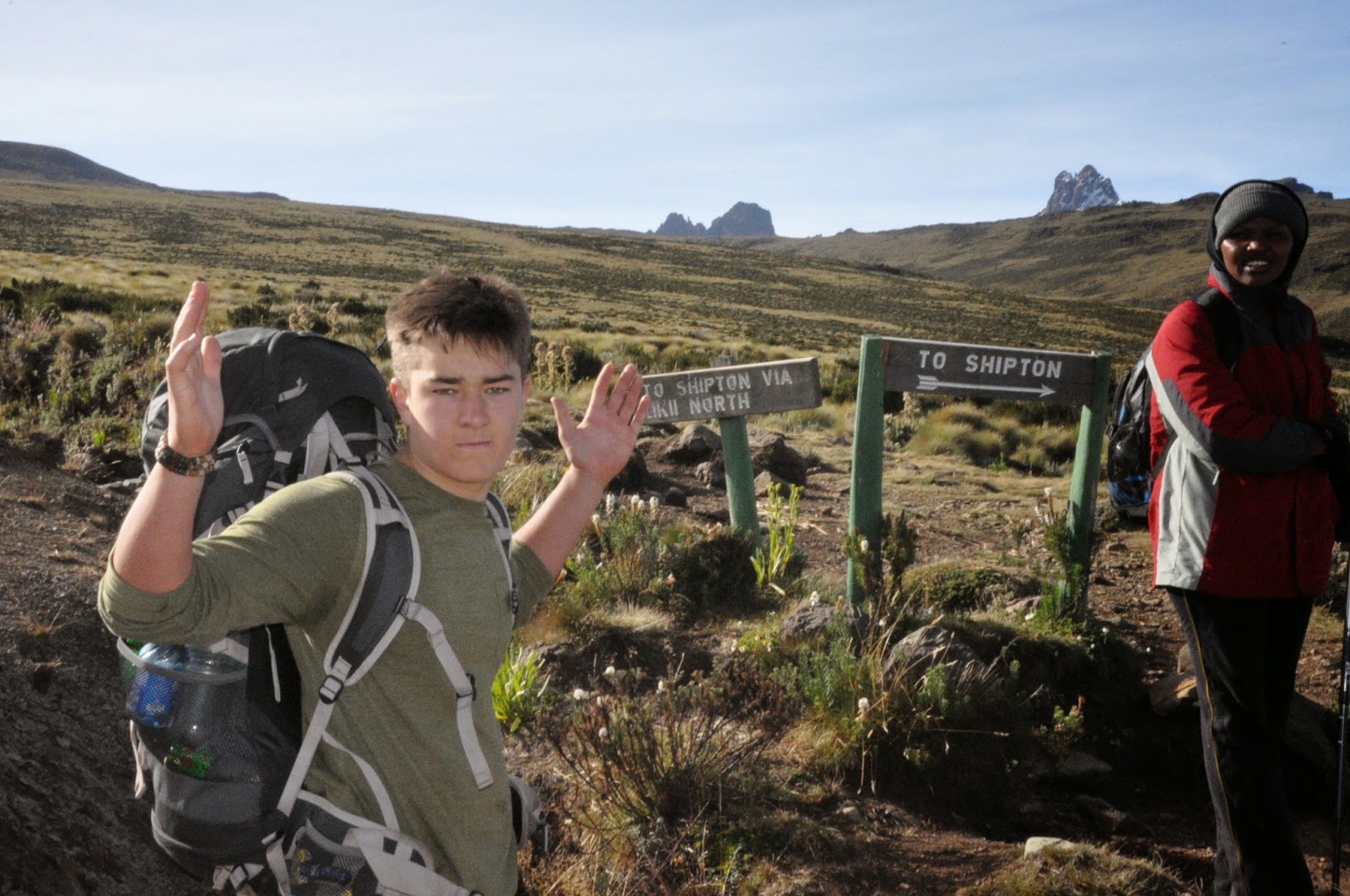
We were driven to the Sirimon gate, of Mt. Kenya National Park, to commence the climb. Shem and his team of porters were  already there and while we were sorting out our gear they were taking care of getting a light lunch ready as we had a 10km walk to our first overnight stop, Old Moses.  It was great to have  along the local dignitaries, who were encouraging the team. From this perspective,  Mt. Kenya was readily visible and it became very clear that we had quite a hike and serious climb ahead of us. 

As we arrived at Old Moses camp, we were greeted by hot tea and snacks by Shem’s cooks and we  recognizing that we would be sleeping on bunks in the cold with no running hot water,  or showers, or heat.  The temperature had already dropped quite a bit as we were now at 3500 m. Everyone quickly started to put on warm clothes and bundle up. Many of the Kenyans had never experienced such cold weather, or eaten a meal with hats and gloves on!  A generator turned on the 3 light bulbs for a while but it didn’t take too long before we were all off to bed and much needed rest.  For some it was a restful night, for many however it was a night of waiting until morning came.  The wind that evening was very strong creating a cacophony of noise between the tin roof and the howling.  There were some snorers in the group as well which made for an interesting night of no sleep for yours truly! 
 
We awoke at 6:00 am and by 6:30 am we were having a good, hot breakfast provided by Shem’s cooks.  At 7:00 am we began our 16 km trek to our next camp, Shipton’s.  The trek to Shipton’s can only be described as beautiful. We had excellent weather, saw a family of elephants and many antelope on distant slopes.  The hike is a very steady uphill march through African heather and moorland.  The sun was strong and the wind would come and go depending on where you were. We were very lucky to have clear skies the whole way up, as sometimes it can be quite cloudy and wet on this climb.  Although the climbing was not easy, all the climbers were making good time up the mountain. We were treated to a delicious lunch next to a stream running from the mountaintop. The lunch  powered us up for the next 4 hours of trekking.  Testing some kind of outdoorsman theory of lunacy, Liam decided that this would be a good place to wash up, in the ice cold water! 


At the Peak!


We began  the next  4 hours of trekking and they went by smoothly, with climbers were chatting and connecting along the way, talking about everything from local Uasin Guishu politics, to their work at AMPATH, the beauty of Kenya, medicine,  and photography.  Arriving at Shipton’s, we were greeted by 3 green wooden buildings, a few other climbers and a clear indication that the next day would be tough. Mt. Kenya rose steeply  in the distance and gave us all pause. We all looked at it and wondered how in the world we would get up there!

Shem’s team had another wonderful meal of pasta with chicken and sauce  ready for us and we all heartily enjoyed it as we were hungry and very cold.  Even Jody and Jen, our Canadian friends, were cold, so this tells you that it was serious.   There was lots of discussion about the upcoming climb and the fact that we would all be getting there together.  It wasn’t too long before we went to bed hoping for sleep as the alarm clocks were set to go off at 2:00 am so that we could get up to the peak by sunrise. Sleep again eluded a number of us…either because we were nervous, cold, the   noise from the  wind or the wonderful orchestra of snorers!

At 2 am Dr. Busakhala saw to it that all were awake, whether we were ready or not. We had tea and crisps at 2:30am and then up the mountain at 3:00 so that we wouldn’t miss the sunrise.
As we began the last leg of the climb  each of us had to use a headlamp.  Frankly when you think about it this seems rather crazy, particularly given the 40 km winds and the cold, but off we went nonetheless.  For nearly 4 hours we slowly made our way up the mountai in the dark. Our guides were simply excellent, making sure that we moved at a safe pace, drank water and that we were feeling ok.  Feeling good was not an option as you were feeling cold, your muscles ached and you were concentrating on moving forward.  For those of us who struggled, the guides were there at each step to encourage us as well as help us up the mountain.  At this point we were already above 5000 m, and the elevation caused even more of a challenge.  Fortunately, again , the skies were clear and  the sun rose spectacularly creating a  breathtaking view! Some of us saw Mt. Kilimanjaro(in Tanzania) in the distance and other mountain ranges as well.  We were all thrilled and excited to have made it to the top of Mt. Kenya!

Although the climb up was tough, the climb down was simply scary.  The loose gravel had you wondering if your footing was going to hold.  Again, Shem and his team did a great job helping team members down the mountain side.  It was inspiring to see these perfect strangers develop a bond that was based on trust and safety.  These guides knew the mountain and how to move up and down it safely and they shared that knowledge with our group of novice climbers.  Many of the team members had their hands held as they came down the mountain. This was serious business as an error would prove at a minimum to be very painful.  By 10 in the morning, we were all safely back down the mountain and treated to a wonderful breakfast.  That was the first part of a long day because at 11:00am, we started our 16km trek back down to Old Moses.

The team had determined that warm showers and a reasonably warm bed were the goal for the night so we skipped lunch and trekked on down to Old Moses.  It was another beautiful day and the valley was breathtaking to walk through…..but nonetheless a very long trek.    By early evening we were all back at Old Moses where Shem and team had another delicious meal ready for us, making the long day worthwhile.  We enjoyed the meal and thanked Shem and his team, had another look at Mt. Kenya and then made our way back to Nanyuki.  There we were greeted by warm showers, warm beds and a good night’s sleep….. no wind…..and no snorers.


We all reflected on the correlation between climbing a mountain and fighting cancer or other chronic disease.  Our challenge was significant but it paled in comparison to the challenge faced by those fighting cancer, heart conditions, diabetes or other chronic diseases.  We can be thankful for our health and also be determined to help those who are faced with difficulties day in and day out.  Mt. Kenya is a sacred place to many of the Kenyan people. Having climbed that mountain we can all appreciate better why this mountain is such a special place.

Sunday, February 16, 2014

Secure or Insecure? That is the Question...

Kenyans are very “security” sensitized so when you live here you automatically are required to think about the topic perhaps more than you are used to or want to. Of course, it is somewhat normal in this day and age to be aware of real and  imagined “security issues” and what I've concluded is that everyone feels differently about what makes them feel insecure.  It is a curious topic, I find, and intriguing because everyone’s view is different. Some of the “issues” in Kenya are fairly normal everywhere, like robbery, especially in big cities or urban areas where there is a large disparity in incomes. It doesn’t seem that surprising that there is crime in urban areas worldwide, considering that acquiring more things is everyone’s goal, yet  for a lot of people, just getting by, feeding one’s family, is a struggle. If you travel anywhere, you must be aware of the possibility of robbery, and take normal precautions. That does not mean that you should be paranoid, but being alert is always wise.

 To us, the culture of  security  in Kenya, for normal everyday folks, seem like a potential overreaction. Of course, we haven’t been here very long nor have we lived through much of what the Kenyans have, so we  have to assume that there are reasons for what seem to us rather over zealous precautions.
The  aspect of the security efforts made here in Kenya which we find most difficult to get used to, is the absolute baldness about Keeping People Out. The endless use of gates, fences, hedges, guards, guard dogs, barbed wire, electric wire, giant walls of concrete, broken glass and concertina wire on the tops of walls, is a bit off putting. It could be that since, historically, Kenya has been a victim of “land grabbing” i.e. people stealing property that was not theirs, a culture of suspicion arose. The British took a lot of the Africans’ land when they came to Kenya, then when they finally left in the early 60’s, they gave a lot of that same stolen property—much of which had been in families for generations---not back to the people it belonged to, but to others—mostly people who had been “loyal” to the British throughout the fight for independence. The repercussions from land grabbing are ongoing and have not yet been settled! During the fight for independence, there was a lot of trespassing and  violence, and perhaps that is when the cultural phenomenon of guarding one’s property became so prevalent. In fact, there are many pieces of property here which have signs saying “This land is not for sale” rather than the other way around! There have been historical occurrences of various tribes taking over other tribes' regions as well, and of course long ago there were lots of wild animals around so fences became prevalent in areas where there is farming. So, there are perhaps many logical reasons for this heightened security. As an outsider, they are sometimes difficult to understand.
Frankly, at first, we found it both disconcerting and unwelcoming in general, but that does seem to be the  point. After 17 months, we have grown habituated and would probably be surprised to come across a property without a giant gate and a guard even though we personally have never had a negative experience with trespassing or intrusion. Although we laugh about it and find some settings and situations outright absurd, it has become “normal” now.
In other parts of the world, people also live in “compounds”, where their “yard” is surrounded by a wall of some sort, but it’s not so common, even in other African countries, to have the guards, gates, etc. actually “guarding” the place. This phenomenon of gates around compounds is not just for the well to do either, which is what immediately occurs to someone from the States. Pretty much everyone who has a “house” i.e., isn’t living in the slum right on top of one’s neighbors, or out in a field in a hut, has a gate and fence,  if not a guard. Also, all windows, in all buildings, except perhaps the most basic hut, which often don’t have windows at all, have metal grills on them. So between the gates and guards and hedges and walls and the metal grills on all the windows, one has an unusual awareness, which feels borderline obsessive to me, of the potential intruder lurking outside.  In the construction of new buildings, they are an automatic accessory, like a door or something, so the business of “protection” and “security” is quite broad here.
There are at least a million security companies in Kenya. We have come to view them as “employers” which seems like a good thing since there is so much unemployment here. However it can be disturbing to walk into almost any setting, a restaurant, bar, grocery store, bank, hospital, or school, and find armed guards. Usually these folks are in some sort of uniform, often in camouflage, which makes their role a little ambiguous (are they military? Police? Security guards?) . They are often carrying, rather loosely over the shoulder or across their laps, large weapons. I am not a gun person but I’m told they are automatic rifles. Their age seems indeterminate and you have to wonder if these people have been trained, if the guns are loaded, if the carriers are stable, etc. It  just gives you pause, or at least, it does me.
The askari (guards) who work guarding places of residence (including our little neighborhood) don’t tend to be armed, and we have pondered whether they are even trained. It is sometimes difficult to take their ability to protect us, too seriously. They do have their uniforms and hats which make them look very official.  They are nice enough people and probably not paid well, considering what we pay the company, and word has it that being a guard is a pretty low level job. We have debated initiating a change in the company, hiring our own, etc., but no one else in the neighborhood seems terribly inclined to change the status quo. Since we are the newcomers, renters , and nonnatives, we have not pushed the topic too hard.
It was interesting talking to our recent guest, Jackson, about the guards and guns as he was pretty surprised about how many of them were walking around in town and in certain shops with their large guns out in view. He was noting it at one point while grocery shopping,  and I remarked  that the big difference is that in the US lots of people are carrying weapons, but they are concealed, so we don’t really know about them. He asked me, wisely, “so which makes you feel less safe?” I do think that knowing that lots of people are carrying concealed weapons makes me feel unsafe but at the same time, having a lot of young potentially untrained men and women carrying weapons doesn't make me feel very  safe either. That could just be me, though. I don’t exactly walk on eggs around them, but I do try not to cross their paths either.
I have met many  people from different  countries who come through here and are pretty nervous about “security” issues . My personal take is that the violence that happens in Nairobi mostly is targeted at certain people in certain areas so it is wise to avoid those places. Of course there is always the possibility of random violence that will strike when you are there or someone you love is there, but that is true in the US also. I feel more nervous about the random gun violence in the US than I do about the infrequent and semi-focused acts of violence here in Kenya. Sadly, those acts that do occur are highlighted in the western press, making Kenya sound like a pretty unsafe place. It isn’t really. 
 When people come  to Eldoret with AMPATH, they are advised not to wander the streets at night, but after being here for a while we have definitely gone out at night, to hear music, mostly, or to check out a new bar or restaurant  that has been recommended. We stick together and we don’t wander. I wouldn’t wander here at night anyway mostly because what makes me feel most insecure is the possibility of stepping in a hole or getting hung up on a random piece of metal sticking out of the ground! With no streetlights, sidewalks in bad shape, and open drainage ditches, that is where the biggest risk may be. Otherwise, I don’t feel any more threatened than I do in any big city at night at home.
One night during the rainy season last year, we were trying to get to dinner at our favorite Indian restaurant with the rest of the IU group and there was an enormous traffic jam so we were definitely going to be late.  Suddenly a downpour started and the streets were running with dirty water, people were dodging the rivers of water and traffic was becoming more aggressive and intense.  We decided to park and walk, which I was a little nervous about because I was not dressed for the rain, did not have an umbrella,  and it was getting dark. Somehow it seemed like a better option than sitting in traffic in the rain, so we found a parking spot, amazingly, and jumped out.  We started our walk on a very  muddy path where traffic was coming up behind us in the dark. We were  in single file, getting sucked into the mud, with very low visibility, as cars, motorcycles and matatus without headlights, drove by us, spraying us with muddy water. Yes, we wanted that meal! My main concern became  turning an ankle or getting stuck in these mud holes so I was completely focused on the path ahead. Liam was marching forward like a soldier and Michael was behind me trying to encourage me and keeping an eye out for my well-being. All of a sudden we heard a  low ‘puttputtputt” of a motorcycle approaching us from behind very slowly.  My wet hair began to stand up on my neck…. “Greven”  a man’s Kenyan voice called as he approached very nearby. We turned to see our friend Samuel on his motorbike, driving slowly next to us, “Hey Samuel!” we greeted him without looking away from our path too long.  I’m sure we looked  like soaked rats. “Are you alright?” he asked with a grin beneath his helmet. “well, yea, we are getting a bath, but we are ok!. Thanks!” Michael responded. I’m sure if we had said “no”, he would have come and picked us each up individually and delivered us to the restaurant, but riding on a motorcycle is considered VERBOTEN here for us so we just kept trudging through the mud. We made it to the restaurant soaking wet and mud covered,  but unscathed, and we were not the last ones to arrive.

So yes, we have taken some risks, when circumstances have called for it (a good free Indian meal) but we have also avoided certain situations. As time goes by, we get more input about places that seem insecure or where the security is improving, we pay attention to the news and we try not to take risks. However,  what has become clear on this adventure is that what could be perceived as  perilous, is certainly relative.  


guards in front of mall/checking cars upon entry

a church (note the crosses on the fence)


our windows/hedges 

our front door with an intruder trying to get in


a gate in front of a church

papyrus/wood/metal